
The Amazing Race Australia: Celebrity
Edition Season 9 in Nepal
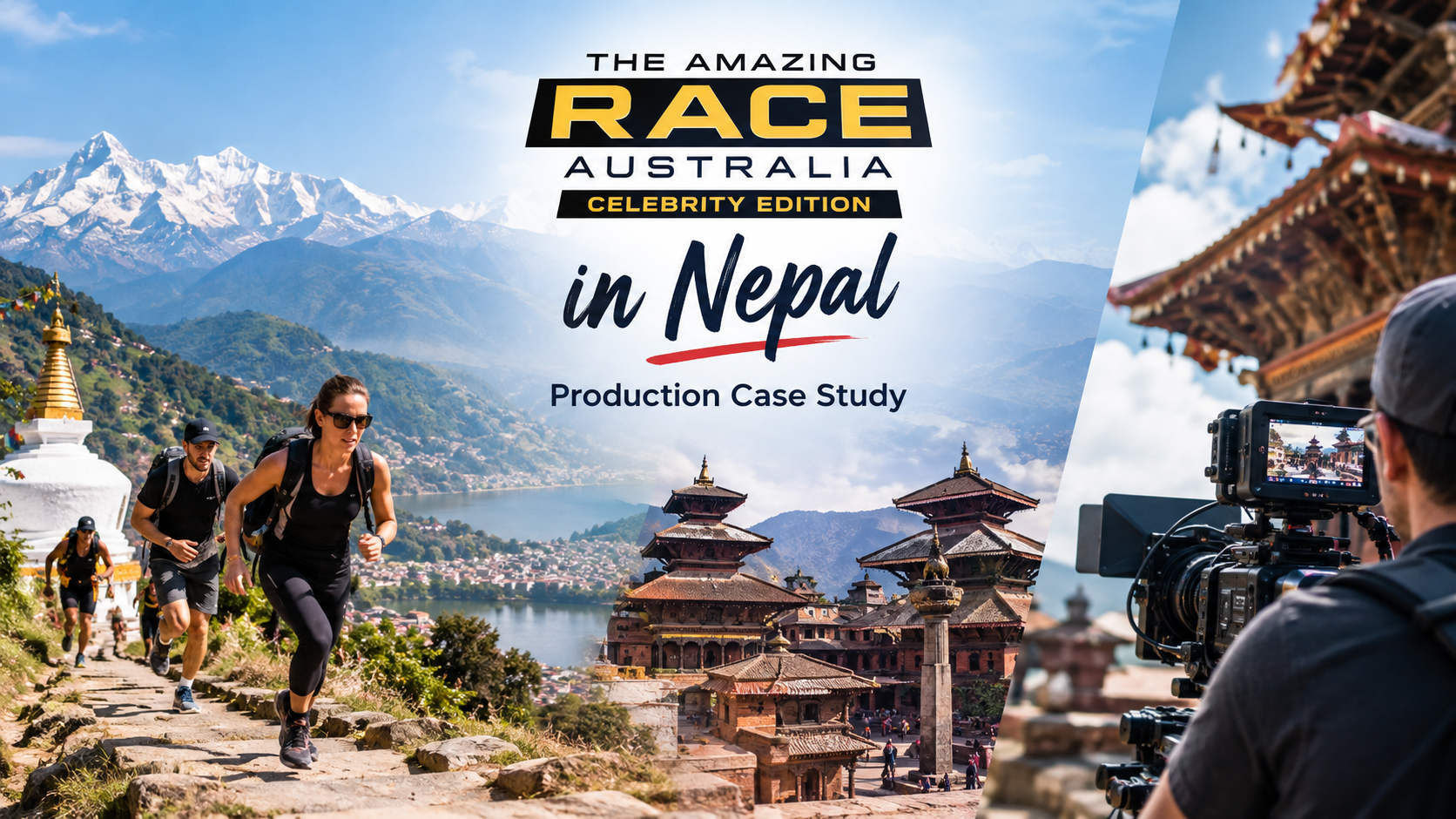
When The Amazing Race Australia: Celebrity Edition came to Nepal in 2025, Nepal was more than a scenic backdrop. Its landscapes, communities, heritage sites and local traditions became part of the race itself.
The Nepal stages took contestants from the Himalayan setting of Pokhara and Sarangkot into Kathmandu and the historic cities of Patan and Bhaktapur.
For viewers, the result was fast-paced reality television. For a production team, however, a format like The Amazing Race Australia requires detailed planning behind the scenes: filming permissions, location access, transport, crew coordination, equipment movement and the ability to keep several moving parts on schedule.
Nepal Film Production provided local production support during the Nepal stages, including travel logistics, permits and on-ground filming coordination.
The Amazing Race Australia Started Its 2025 Season in Nepal
The 2025 Amazing Race Australia: Celebrity Edition featured 13 celebrity teams and their partners or family members, with Beau Ryan returning as host.
The race began in Nepal before continuing through Uzbekistan, Sri Lanka, Taiwan and Indonesia. The winning team competed for A$100,000 for its chosen charity.
Nepal featured across the opening three episodes of the season.
Leg 1: Pokhara and the Himalayas
The starting line was at Shanti Stupa in Pokhara.
From there, contestants raced through locations around Pokhara and nearby Dhampus, with challenges involving Phewa Lake, a Buddhist monastic school, local agricultural practices and monasteries.
Rather than simply showing Nepal's mountain scenery, the episode incorporated local places and activities directly into the competition.
Leg 2: Sarangkot, Pokhara and Kathmandu
The following leg began around Sarangkot and Pokhara before teams travelled by air to Kathmandu.
Tasks included the Sarangkot zipline before contestants flew from Pokhara to Kathmandu and continued through locations including Shree Gha and Swayambhunath.
For production, this type of route creates a different logistical challenge from a conventional single-location shoot. Contestants, production personnel, equipment and transport support all have to move while the race remains operational.
Leg 3: Patan and Bhaktapur
The third Nepal episode moved deeper into the cultural landscape of the Kathmandu Valley.
Teams travelled to Patan Durbar Square before continuing to Bhaktapur. Challenges involved transporting water, making pottery, restoring a traditional door and cleaning roof tiles associated with temple reconstruction.
Locations included Manga Hiti at Patan Durbar Square, Pottery Square, areas around Golmadhi and Bhaktapur Durbar Square, with the leg finishing at Nyatapola Temple.
These locations are important to distinguish from Kathmandu Durbar Square. Patan and Bhaktapur are separate historic cities and form their own monument zones within the UNESCO-listed Kathmandu Valley World Heritage property.
Why the Nepal Episodes Worked on Screen
The strongest travel and reality television sequences often come from making the destination part of the story.
That is what happened during the Nepal legs.
Teams did not simply complete generic physical challenges against mountain and temple backgrounds. They interacted with local agricultural practices, Buddhist traditions, pottery, Newari food, water systems and traditional architecture.
That creates stronger television, but it also increases the complexity of the production.
A challenge built around a working square, monastery, workshop or heritage neighbourhood requires considerably more coordination than filming on a controlled set.
Production teams need to consider location owners, government authorities, local communities, public movement, cultural sensitivities, participant safety and the technical requirements of the camera and sound departments.
That is where experienced film production support in Nepal becomes particularly important.
What Large-Scale Reality TV Production in Nepal Requires
Reality competition television operates differently from a documentary or conventional commercial shoot.
The schedule is driven by contestants. Multiple camera teams may need to work simultaneously. Locations can change quickly. Transport has to remain available, and production departments need contingencies when a challenge or race leg runs longer than expected.
For a large reality TV production in Nepal, several areas require particular attention.
Filming Permits and Heritage Clearances
Productions should determine permit requirements before locking the shooting schedule.
Nepal can require national filming permissions as well as additional approvals depending on the location and type of production. Heritage sites, protected areas, drone operations and other controlled locations can involve separate authorities.
This becomes particularly important in the Kathmandu Valley.
Patan Durbar Square and Bhaktapur Durbar Square are two of the seven monument zones that make up the UNESCO Kathmandu Valley World Heritage property. Working in culturally sensitive heritage environments requires coordination beyond ordinary public access.
Our filming permits in Nepal service helps international productions identify the authorities, documents, clearances and lead times relevant to their locations.
For producers researching a "Pokhara filming permit," it is also important to understand that there is not necessarily one standalone permit covering every type of production in Pokhara. Requirements depend on the project, location, equipment and filming activity.
Multi-Camera Crew Coordination
A race format can require camera and sound coverage around several teams at the same time.
That means crew allocation needs to be planned around the route rather than around a conventional single-unit shooting day.
Local production knowledge becomes especially useful when camera teams are moving between busy cities, heritage areas, monasteries, rural roads and mountain locations.
International productions can supplement travelling departments with experienced local crew and technicians in Nepal, including camera operators, assistants, sound teams, grips, production assistants and other technical roles.
Moving Between Pokhara and Kathmandu
Pokhara and Kathmandu are two of Nepal's main production hubs, but moving a large television unit between them still requires careful planning.
For a production using domestic flights, passenger movements are only one consideration. Equipment allowances, checked baggage, cargo, ground vehicles, airport transfers and timing at both ends must also be coordinated.
A race format makes this even more sensitive because the production cannot simply move everything at a relaxed pace after completing a location.
Transport, accommodation and equipment movements therefore need to be integrated into the production schedule from the beginning.
For larger projects, experienced line production in Nepal can centralise the budget, schedule, permits, transport, accommodation, local crew and other production requirements.
Equipment, Customs and Insurance
International reality productions often travel with substantial camera, sound, communications and production equipment.
The equipment plan should be finalized early enough for temporary import requirements, equipment documentation and insurance arrangements to be coordinated with the filming schedule.
Productions bringing professional equipment into Nepal can use our clearance and insurance support for temporary imports, customs documentation and relevant production insurance requirements.
Community and Location Coordination
Some of the most memorable Nepal challenges took place in living cultural environments rather than closed sets. That requires a different production approach. Residents, businesses, craftspeople, religious institutions and location managers may all be affected by filming. Public access may also need to continue while the production operates.
Good local coordination therefore involves more than securing a signature on a location agreement. Participants and stakeholders need to understand what will happen, when the crew will arrive, how much space will be needed and how normal activity will be affected.
Done properly, this helps the production work with the location rather than against it.
Our Production Support for The Amazing Race Australia in Nepal
Nepal Film Production supported The Amazing Race Australia: Celebrity Edition during its Nepal production. Our team managed travel logistics, filming permits and production support required for the Nepal stages. For an international format with moving locations and a fixed production schedule, having a central local production team creates a clear point of coordination between the international production and suppliers, authorities, locations and local stakeholders.
A location change may affect a permit. A flight change may affect vehicles and accommodation. A delayed challenge can affect another location's access window. Managing those relationships together is an important part of large-format television production. You can see The Amazing Race Australia and other international productions in our production portfolio.
What International Producers Can Learn From This Production
Nepal is capable of supporting complex international reality television, factual entertainment, commercials and multi-location productions, but preparation matters.
For large-format projects, producers should:
Map permit requirements early. Identify national, heritage, aviation, drone or protected-area approvals before finalising the route.
Recce operationally, not only creatively. A beautiful location still needs crew access, holding areas, power, sound conditions and transport.
Build transport around the production unit. Crew, contestants, camera equipment and production vehicles may all move differently.
Plan contingencies. Weather, traffic, aviation and challenge overruns can affect tightly connected schedules.
Use one accountable local production structure. Central coordination makes last-minute decisions considerably easier to manage.
The larger the format becomes, the more important these dependencies are.
Why Nepal Works for International Reality Television
Nepal offers something that is difficult to reproduce elsewhere: dramatic changes in geography and culture across relatively short distances.
A production can move from Himalayan panoramas and lakes around Pokhara to dense historic neighbourhoods, temples, monasteries and traditional squares in the Kathmandu Valley.
That visual range gives producers several distinct environments within one country.
More importantly, Nepal's everyday life can provide meaningful storytelling opportunities when productions work respectfully with local people and places.
The Amazing Race Australia demonstrated this well. Nepal was not simply photographed. Its culture, crafts, food, landscape and architecture became part of how the competition unfolded.
Planning a Reality TV or International Production in Nepal?
Nepal Film Production is a Kathmandu-based film production and fixer company supporting international television, documentary, commercial and branded-content productions across Nepal.
Our services include filming permits, line production, local crew, equipment support, location coordination, customs clearance, transport and full on-ground production support.
If you are planning a reality series, factual entertainment project or multi-location television production in Nepal, contact our production team to discuss your route, schedule, crew and permit requirements.