
Drone Category for Registration in Nepal: Category
A, B, C & D Explained
How Is a Drone Categorized in Nepal?
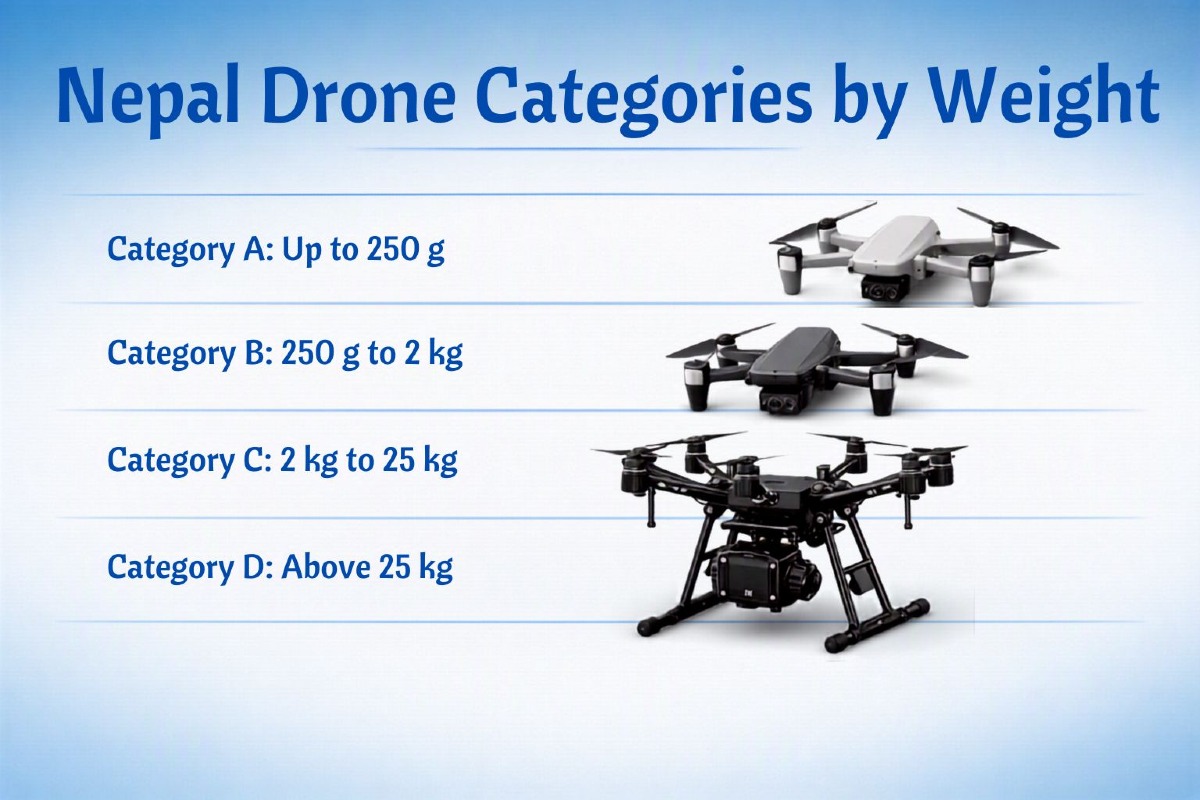
Nepal categorizes drones into Category A, B, C and D.
The category is based on the drone's Maximum Take-off Weight (MTOW).
This is the maximum weight at which the drone is allowed to take off. It is not simply the empty weight of the drone.
The classification comes from the Government of Nepal's Drone Related Procedure, 2019.
Drone Category | Risk Level | Maximum Take-off Weight |
Category A | Very Low Risk | Up to 250 g |
Category B | Low Risk | 250 g to 2 kg |
Category C | Regulated, Low Risk | 2 kg to 25 kg |
Category D | Regulated, High Risk | More than 25 kg |
The government procedure literally uses 250 g as the end of Category A and the start of Category B. It does the same with 2 kg for Categories B and C. So, if your drone's MTOW is exactly 250 g or exactly 2 kg, it is sensible to confirm the category with CAAN rather than guessing.
What Is Category A Drone?
Category A covers drones weighing up to 250 grams.
It is called the Very Low Risk category.
Many small travel and recreational drones fall into this group.
Do not confuse “very low risk” with “no regulation.”
The same government procedure says drones used in Nepal must be registered with the Civil Aviation Authority of Nepal and receive a Unique Identification Number (UIN).
There are limited situations where a Category A drone may not need separate flight permission. For example, the procedure allows certain recreational flights within the person's own premises, up to 50 ft AGL, after informing local police and following the required conditions. This is a flight-permission exception, not a general rule allowing small drones to fly anywhere.
What Is Category B Drone?
Category B covers drones from 250 grams to 2 kg.
It is called the Low Risk category.
Many consumer camera drones used for travel, photography and filmmaking fall within this weight range.
Where flight permission is required, the government procedure says applications for Category A and B drones flying up to 200 ft AGL are handled through the concerned District Administration Office (DAO). Other cases may have to go through the Ministry of Home Affairs.
What Are Category C and D Drones?
Category C covers drones from 2 kg to 25 kg.
It is classified as Regulated, Low Risk.
Category D covers drones above 25 kg.
It is classified as Regulated, High Risk.
These categories usually include larger professional or specialist aircraft.
CAAN's registration requirements specifically add physical-verification requirements for Category C and D drones above 2 kg.
How Do I Know My Drone Category?
Check the manufacturer's specification for Maximum Take-off Weight or MTOW.
Then compare it with Nepal's category table.
For example:
A drone with an MTOW of 249 g falls under Category A.
A drone with an MTOW of 900 g falls under Category B.
A drone with an MTOW of 5 kg falls under Category C.
A drone with an MTOW of 30 kg falls under Category D.
Do not classify the drone only from its product name.
Does the Drone Category Decide Whether I Can Fly?
No.
Your category identifies the risk and weight class of the aircraft.
It does not automatically give you permission to fly.
Registration and flight permission are separate.
Once you know your category, read our drone registration in Nepal guide for the CAAN registration process, documents, current registration fee and UIN.
After registration, you may still need permission from the concerned District Administration Office and other local or concerned authorities based on the location, altitude and purpose of the flight. The government's procedure specifically provides for DAO/MOHA involvement in flight permissions.
For film shoots and professional drone work, Nepal Film Production can handle drone permits in Nepal, including coordination with the concerned authorities.
In Simple Words
Nepal has four drone categories.
Up to 250 g = Category A.
250 g to 2 kg = Category B.
2 kg to 25 kg = Category C.
Above 25 kg = Category D.
Your maximum take-off weight decides the category.
Knowing the category is the first step. Registration and permission to fly are separate steps.