
Netflix Documentary Filmed in Nepal: Behind Hack
Your Health: The Secrets of Your Gut
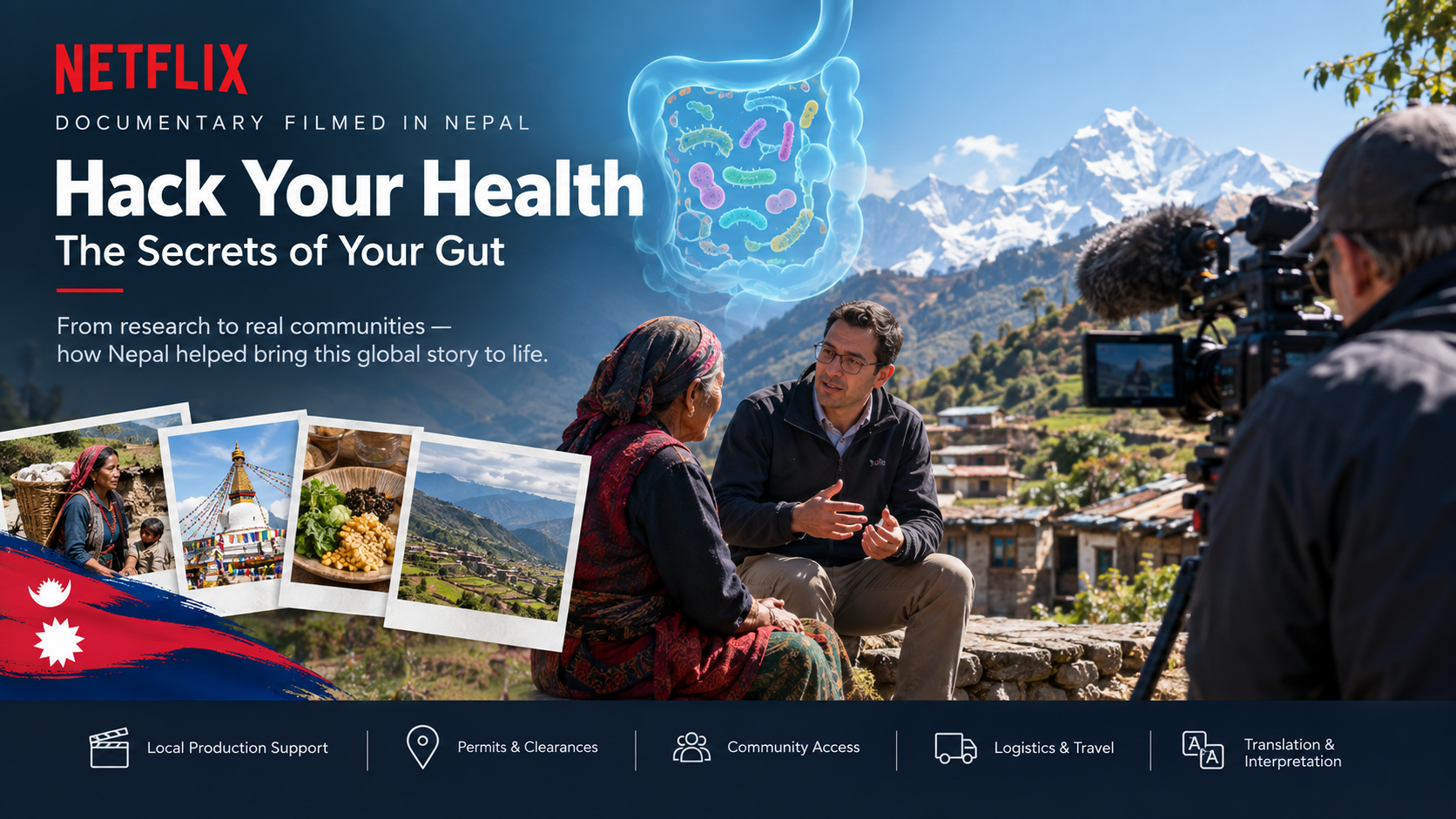
Netflix's 2024 documentary Hack Your Health: The Secrets of Your Gut explores one of the most rapidly developing areas of health science: the human gut microbiome.
Directed by Anjali Nayar, the documentary brings together researchers, doctors and contributors to explain how the communities of microorganisms living in the human digestive system are associated with diet, digestion, immunity and other aspects of health.
Part of the story also takes viewers to Nepal, connecting the documentary with research into how different lifestyles can influence the composition of the human microbiome.
For the Nepal portion of the production, Nepal Film Production provided local production support, helping the international team navigate the practical, logistical and community considerations involved in filming a science documentary in Nepal.
The Nepal Connection in Netflix's Hack Your Health
One of the researchers featured in Hack Your Health is Aashish Jha, Assistant Professor of Biology at New York University Abu Dhabi.
Jha's research focuses on population genetics, microbiomes and traditional Himalayan populations. His work in Nepal has examined how changes in lifestyle, diet and environment are associated with differences in the gut microbiome.
A major study published in PLOS Biology examined the gut microbiomes of four Himalayan populations in Nepal: the Chepang, Raute, Raji and Tharu.
These communities represented different points along a transition from traditional foraging lifestyles toward increasing dependence on agriculture.
Researchers found a strong association between lifestyle differences and gut microbiome composition. The study also reported that microbiome changes associated with the transition away from a traditional foraging lifestyle could become visible within a single generation.
That research gives the Nepal segment of the documentary a much deeper purpose than simply providing an interesting filming location.
Nepal becomes part of the scientific story itself.
Why Nepal Is Important for Microbiome Research
One of the challenges in microbiome science is separating the influence of lifestyle from factors such as geography and human genetics.
Comparing completely unrelated populations from different continents introduces many variables at once.
Research involving populations within the same broader geographical region can help scientists examine lifestyle differences while reducing some of those confounding factors.
Nepal offers researchers access to communities with very different histories of subsistence, agriculture, diet and environmental exposure.
For documentary filmmakers, this also creates an opportunity to visually communicate something that could otherwise remain abstract scientific data.
Instead of explaining the lifestyle gradient only through charts or animation, a documentary can show the communities, environments, food systems and daily routines connected with the research.
That is where film production services in Nepal become especially important. Scientific credibility still has to be maintained while transforming academic research into an understandable visual story.
What Filming a Science Documentary in Nepal Requires
Science and research documentaries often involve more preparation than conventional location filming.
The biggest challenges are rarely limited to cameras or equipment. They usually involve permissions, contributor access, research protocols, language, logistics and trust.
Filming Permits and Location Clearances
Foreign productions filming in Nepal must follow Nepal's official foreign film production process.
The production generally needs to submit documentation covering the project, foreign crew, filming locations, schedule and equipment.
Depending on where filming takes place, additional permissions may also be necessary from the authorities responsible for specific locations, protected areas, heritage sites or other regulated locations.
Working with an experienced local partner for filming permits in Nepal helps identify these requirements before the international crew arrives.
This becomes particularly important for documentaries because schedules often depend on researchers, contributors and communities who may only be available during specific periods.
A permit delay can therefore affect much more than a location booking.
It can affect the entire story.
Research Ethics and Contributor Consent
A science documentary involving research participants also requires careful coordination between the filmmakers and the research team.
Research consent and consent to appear in a documentary are not automatically the same thing.
Where filming is connected to an active or previously established research project, producers need to understand the ethical framework governing that research and ensure that documentary activity does not conflict with it.
Contributors should understand what is being filmed, why it is being filmed and how their contribution may ultimately be used.
When rural or Indigenous communities are involved, effective communication becomes even more important.
A knowledgeable documentary fixer in Nepal can help coordinate researchers, contributors, community contacts, local authorities and the visiting production team before filming begins.
Language, Interpretation and Translation
Nepal is one of the world's linguistically diverse countries.
The 2021 national census recorded 124 mother tongues across the country.
That means producers should never assume that Nepali will be the first language of every contributor appearing in a documentary.
For research-based interviews, basic conversational interpretation may not be enough.
Scientific terminology, cultural context and subtle differences in meaning need to survive the entire process from the original interview through transcription, translation, editing and subtitles.
For that reason, translation and transcription services should be planned during pre-production rather than treated as a final post-production task.
Accurate time-coded transcripts also allow editors working outside Nepal to understand what contributors actually said rather than cutting scenes around an approximate translation.
Nepal Film Production's Role in the Project
Nepal Film Production provided local production support for the Nepal portion of Hack Your Health: The Secrets of Your Gut.
Our work covered on-ground production requirements including permits and clearances, fixing, community coordination, local crew support and travel logistics.
Research-focused documentaries require a different production approach from tourism films, commercials or conventional location shoots.
The local production team has to understand not only where the crew needs to go, but also who needs to be consulted before the cameras arrive.
For community-based filming, preparation begins before the shoot day.
Contributors and local contacts need clear information about the production. Researchers may need to coordinate participant access. Transport needs to work around locations that can be difficult to reach. Language requirements need to be identified in advance.
The objective is simple: by the time the international crew begins filming, the production infrastructure should already be in place.
Our broader line production services in Nepal can integrate these requirements into one workflow covering budgeting, scheduling, permits, crew, transportation, accommodation and production management.
What Documentary Producers Can Learn From This Shoot
The most important lesson from research-based filming in Nepal is to involve your local production partner early.
Do not wait until flights are booked and filming dates are fixed.
Start local production planning while research access, contributor participation and locations are still being discussed.
This allows the production team to identify which permissions are government requirements, which permissions relate to specific locations, which issues belong to the researchers' ethical framework and which arrangements need to be made directly with contributors or communities.
Language should be scoped at the same stage.
If interviews will be conducted in multiple languages, producers should determine in advance whether they need on-set interpreters, translated interview questions, time-coded transcripts, subtitles or specialist translators familiar with scientific terminology.
The earlier these requirements enter the production schedule, the less likely they are to become expensive problems during filming or post-production.
Planning a Documentary Shoot in Nepal?
Nepal Film Production is a government-registered film production company based in Kathmandu, providing production support to international filmmakers working throughout Nepal.
Our services include filming permits, fixers, line production, local crew, equipment, location support, travel logistics, translation and transcription, drone coordination and other production requirements.
If you are developing a documentary, factual series, research project or international production in Nepal, contact our team during pre-production so we can review your locations, schedule and permit requirements before your shoot dates are locked.