
SkyShowtime — Krychowiak: One
Step from the Top
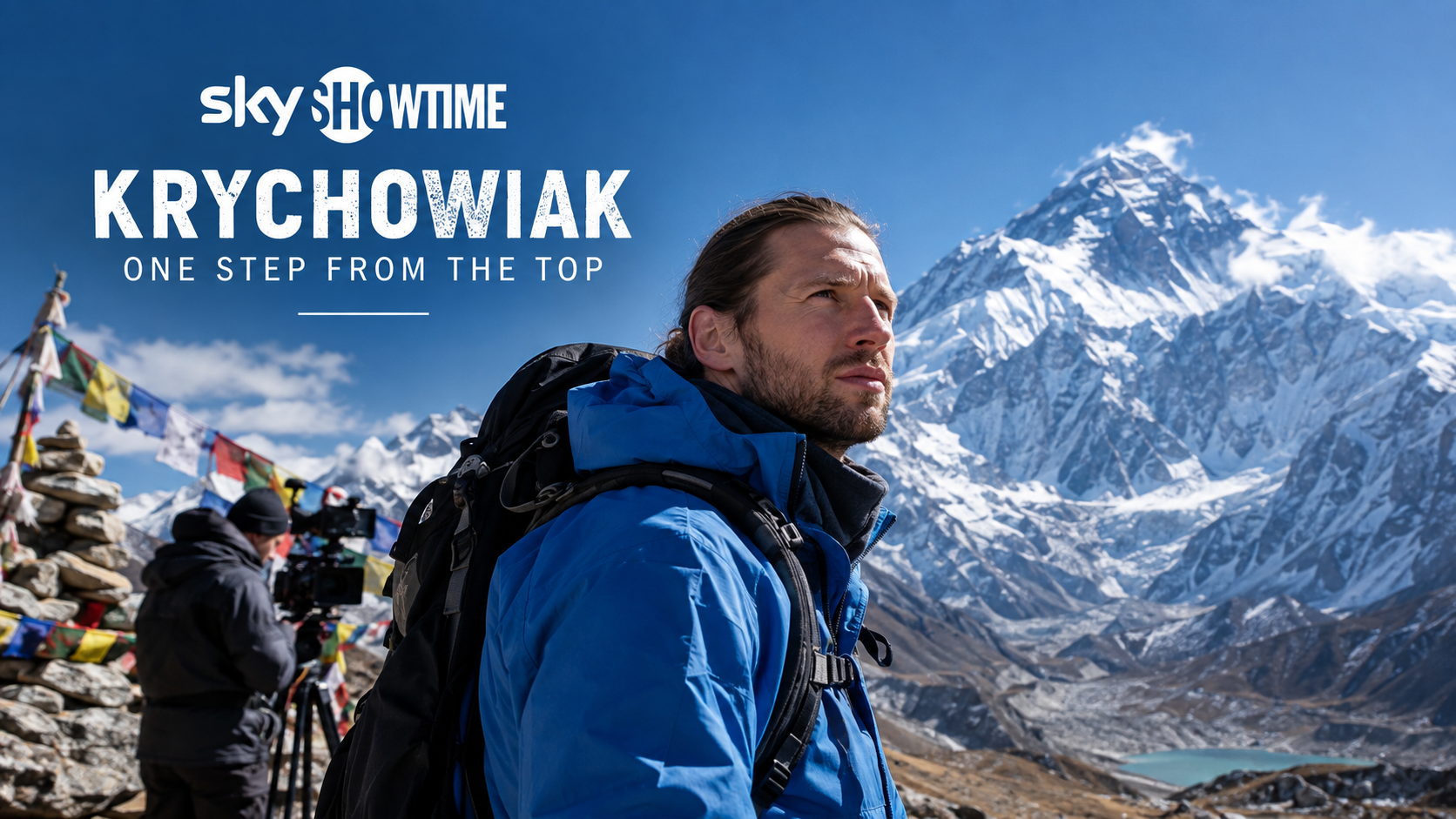
SkyShowtime’s Krychowiak: One Step from the Top (Krychowiak: krok od szczytu) follows former Poland international footballer Grzegorz Krychowiak as he reflects on his career, life beyond football and the challenge of climbing Mount Everest.
For the Nepal segment, Nepal Film Production provided local production support, including permits and clearances, fixing, high-altitude logistics and crew coordination.
The project offers a useful real-world example of what Everest documentary filming in Nepal involves once a production moves from a conventional location into the high Himalayas.
About Krychowiak: One Step from the Top
The four-part documentary is the first Polish documentary production created exclusively for SkyShowtime.
Produced by Papaya Films and directed by Jan Dybus, with Kacper Sawicki serving as creative producer, the series launched across SkyShowtime’s 20+ markets on 27 November 2025.
Rather than focusing only on Krychowiak’s football career, the documentary follows a period of transition in his life. His Mount Everest challenge becomes part of that wider story about ambition, change and what comes after professional sport.
For filmmakers, however, taking that story to Everest changes almost every part of the production plan.
What Everest Documentary Filming in Nepal Actually Requires
There is no single permit that covers every part of filming around Everest.
International productions normally begin with Nepal’s national filming permit process. The exact approvals then depend on the locations, activities, crew and equipment involved.
Because much of the Everest region lies inside Sagarmatha National Park, professional filming within the park requires additional protected-area permission.
If members of a production are also participating in a mountaineering expedition beyond the trekking route or climbing above Base Camp, Department of Tourism expedition requirements, climbing permits, royalties and liaison arrangements can also apply.
Drone filming is a separate process again. Foreign drone operators must comply with Civil Aviation Authority of Nepal requirements, while aerial filming inside protected areas can require additional location-specific clearance. Our drone permit service in Nepal coordinates these approvals with the wider production schedule.
The important lesson for producers is simple: build the permit map before locking the shooting schedule.
Why High-Altitude Filming Needs a Different Production Plan
Everest Base Camp sits at roughly 5,400 metres. At that elevation, altitude is not simply a comfort issue. It directly affects crew performance, movement, equipment management and the number of productive filming hours available each day.
A realistic Everest production schedule therefore needs acclimatisation days rather than treating them as spare time.
Mountain access can also change quickly because of weather. Flights and helicopter movements should never be treated like fixed urban transport connections, so production schedules need contingency days.
Cold conditions create another technical challenge. Camera, monitor, audio and drone batteries provide less operating time in low temperatures, which means charging, storage and battery rotation need to be planned as part of the shooting workflow.
For international crews, this is where experienced local film production support in Nepal becomes especially important.
Why Local High-Altitude Camera Crew Matters
A technically strong camera operator is not automatically a high-altitude camera operator.
At elevation, the crew must be able to manage their equipment while moving safely, working efficiently and recognising when altitude or weather conditions require the plan to change.
For expedition and sports documentary work, international directors and DoPs can be supported by experienced Nepali crew and technicians who understand both international production expectations and Himalayan working conditions.
This becomes increasingly valuable as locations become more remote and every additional piece of equipment, battery and crew movement has a logistical cost.
Medical and Evacuation Planning Comes Before the Shot List
High-altitude productions also need a clear medical plan.
Crew members require appropriate acclimatisation, and anyone developing serious or worsening altitude symptoms must be able to stop ascending and descend when necessary.
Productions should confirm evacuation procedures, communication systems and insurance coverage before entering the mountains. Insurance should specifically be checked for high-altitude activities and helicopter evacuation rather than assumed to include them.
For an Everest production, the medical plan should influence the schedule, not be added after it.
Our Role in the Nepal Production
For Krychowiak: One Step from the Top, Nepal Film Production supported the production in Nepal with local coordination covering permits and clearances, fixing, high-altitude logistics and crew management.
Our approach to expedition filming begins with three things: permissions, the operating window and the safety plan.
From there, our film fixers in Nepal coordinate the practical details required to turn the international production plan into something that can actually be executed on the ground.
This kind of local preparation is particularly important in the Everest region, where changing one location or production day can affect transport, accommodation, crew, permits and weather exposure at the same time.
What Producers Can Learn From an Everest Shoot
The most useful way to approach Everest is to treat it as an expedition with a film production attached to it, rather than a conventional shoot that happens to be at altitude.
Start with access, safety, acclimatisation and evacuation planning. Build the production schedule around those realities. Only then should the final shooting plan be locked.
That approach gives directors more flexibility when conditions change and reduces the risk of losing critical filming days to problems that could have been identified during pre-production.
Planning an Everest Documentary or Expedition Shoot in Nepal?
Nepal Film Production is a government-registered production and fixer company based in Kathmandu, supporting international documentaries, television productions, branded content and expedition films across Nepal.
We provide filming permits, national park and drone clearance coordination, local crews, fixers, logistics, equipment and full production support from pre-production through wrap.
Planning a documentary or expedition shoot in Nepal? Contact our production team for an initial project consultation.
Frequently Asked Questions
What permits are needed to film around Everest?
International productions generally require Nepal’s national filming permission together with any location-specific approvals. Filming inside Sagarmatha National Park requires additional protected-area permission. Mountaineering activity and drone filming have separate regulatory requirements.
The exact permit combination depends on the route, altitude, production activity, equipment and whether the crew is trekking or participating in an expedition.
Do you need a separate permit to film at Everest Base Camp?
Professional filming in the Everest region should be assessed as part of the complete production permit plan. Because Everest Base Camp lies within Sagarmatha National Park, protected-area filming requirements need to be considered in addition to Nepal’s national filming authorization.
Can you provide a high-altitude camera crew in Nepal?
Yes. Nepal Film Production can coordinate experienced Nepali camera operators, technicians, mountain crew and production support for high-altitude shoots.
The crew configuration is selected according to altitude, route, production scale, technical requirements and shooting schedule.
Do drone shots around Everest require separate permission?
Yes. Drone operations have their own aviation and location-specific requirements. Foreign productions should confirm CAAN registration and operating requirements along with any additional national park or security clearances before scheduling aerial filming.
How far in advance should an Everest documentary be planned?
Several months of preparation is preferable for a complex international production.
Permit processing, expedition logistics, crew availability, equipment planning, insurance and weather windows all need to be coordinated. Nepal’s spring and autumn periods are particularly important planning windows for trekking and expedition productions.