
The North Face BELONGING: Filming
at Annapurna Base Camp, Nepal
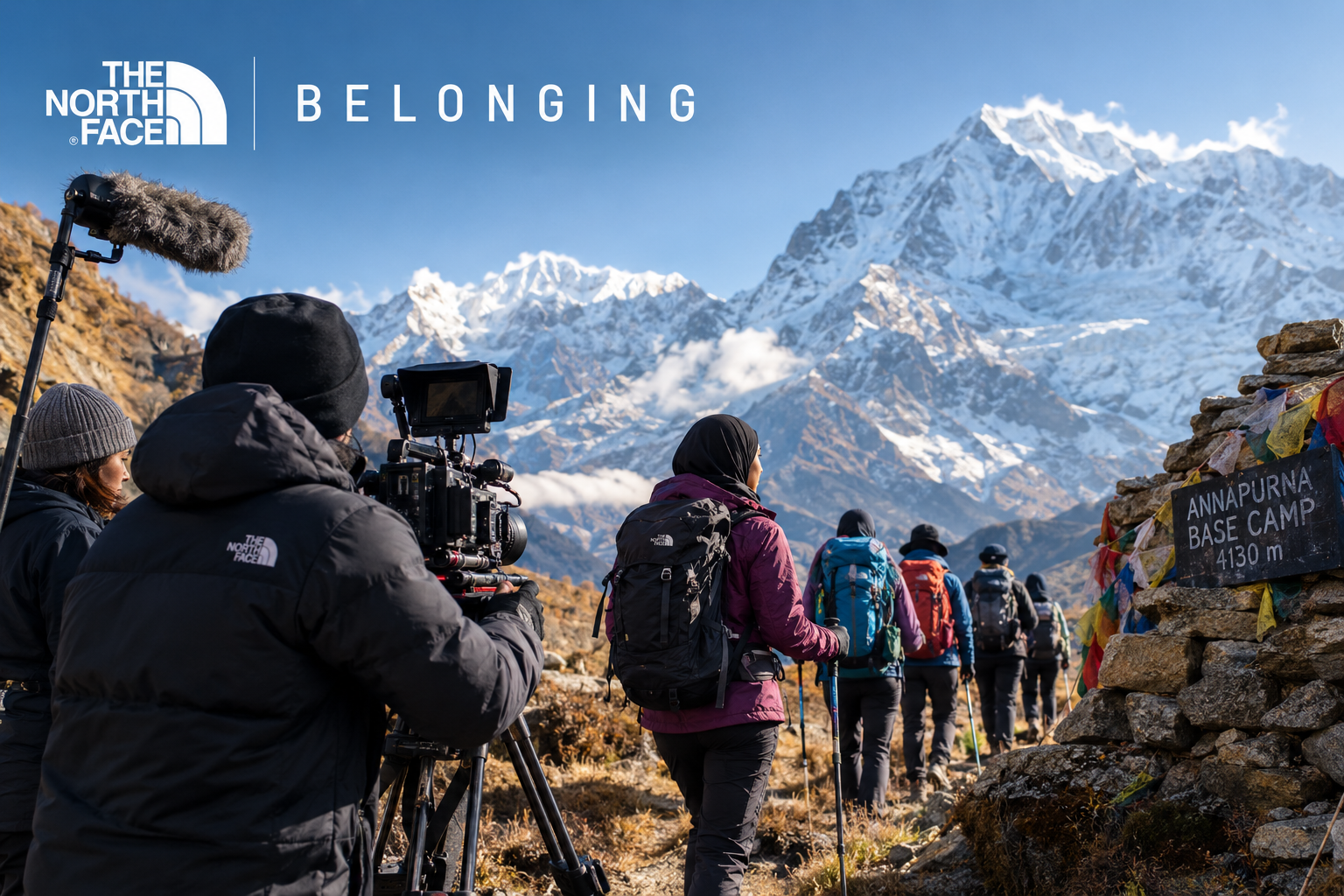
BELONGING is a short film from The North Face following mountaineer and expedition leader Amira Patel through Nepal’s Himalayas on a journey toward Annapurna Base Camp.
Amira is the founder of The Wanderlust Women, a hiking and adventure community created to encourage Muslim women to feel confident and represented in outdoor spaces. The six-minute film follows her alongside a female-supported team as the physical challenge of the trek becomes part of a wider story about identity, sisterhood and belonging.
Produced by Knowjack Media for The North Face, the project also required experienced local support for filming in Nepal’s mountain environment. Nepal Film Production supported the Nepal production, including local coordination, permits and conservation-area requirements, fixing, crew support and trail logistics.
For us, it is a strong example of how an outdoor brand film in Nepal works best when the production schedule follows the reality of the mountains rather than treating the landscape simply as a backdrop.
Why Annapurna Works for Outdoor Brand Films
The Annapurna region offers something particularly useful for visual storytelling: the landscape changes naturally as the journey progresses.
Depending on the chosen route, productions can move through cultivated hillsides, forest, mountain settlements and increasingly dramatic alpine terrain before entering the Annapurna Sanctuary. That transition gives filmmakers a visual narrative without needing to manufacture one.
Pokhara also serves as the main production gateway to much of the Annapurna region, making transport, equipment preparation and crew movement more practical than many remote Himalayan locations.
However, strong mountain imagery starts before the cameras arrive. Our location scouting services assess access, light, altitude, weather exposure, accommodation, power availability and permit requirements before a production commits to a location.
For trekking films, these practical factors can be as important as the view itself.
Filming Inside the Annapurna Conservation Area
Annapurna Base Camp lies within the Annapurna Conservation Area, a protected area administered through Nepal’s conservation system.
This means an international commercial production should not treat a normal trekking permit as permission to conduct a professional shoot.
Foreign trekkers require the applicable conservation-area entry documentation, while professional filming may require additional location-specific authorization. Our National Park and Conservation Area filming permit service helps productions identify the relevant authority, prepare documentation and coordinate protected-area filming clearance before the crew enters the trail.
If aerial footage is planned, drone operations have a separate approval process. Depending on the aircraft, purpose and location, approvals may involve the Civil Aviation Authority of Nepal and additional authorities responsible for the filming area.
Crews planning Himalayan aerial work should therefore arrange drone permits in Nepal during pre-production rather than assuming a ground filming permit also covers aerial filming.
The Production Reality of an Annapurna Base Camp Shoot
Annapurna Base Camp filming is very different from a conventional commercial shoot.
Once the production moves onto the trekking route, vehicles are no longer available for much of the journey. Camera bodies, lenses, batteries, sound equipment, personal kit and production supplies have to be planned around what the crew and support team can realistically move through mountain terrain.
Power may be available at lodges along parts of the route, but capacity and reliability vary. Battery strategy, data management and equipment redundancy therefore need to be planned before departure.
Altitude also changes how a crew works. A technically strong camera operator is only useful on a Himalayan production if they can safely keep pace with the schedule and still perform once they reach the location.
That is why we match mountain projects with suitable film crew and technicians in Nepal, rather than approaching a trekking production like a city-based commercial shoot.
Weather adds another variable. Mountain conditions can change quickly, so schedules need enough flexibility to move landscape sequences, interviews and observational coverage when visibility changes.
The strongest mountain productions work with those conditions rather than fighting them.
Filming a Story About Women in the Outdoors
BELONGING is not simply a film about reaching a destination.
Its central story is Amira’s relationship with outdoor space and the confidence that develops through shared experience. The female-supported expedition therefore becomes part of the storytelling rather than just a production detail.
For projects built around representation, authenticity needs to extend beyond casting.
Local guides, production support, contributors and cultural context all affect how the finished story feels. When a brief requires female guides, mountain professionals, contributors or crew, these roles should be identified and booked during pre-production instead of being treated as last-minute additions.
A local film fixer in Nepal is particularly valuable for this kind of production because trail logistics, community coordination, transport, accommodation and permit requirements need to work together.
Nepal Film Production’s Role in BELONGING
Nepal Film Production provided local production support for BELONGING during the Nepal shoot.
Our work included support with filming permissions and conservation-area requirements, local fixing, crew coordination and mountain logistics.
This is the same approach we use for international documentaries, commercials, expedition films and branded productions requiring film production support in Nepal.
For trekking-based projects, we plan around the route, altitude, weather, available light and the physical capacity of the team first. The shot plan is then built around those realities.
That approach protects both the production and the story.
What BELONGING Shows About Filming Outdoor Campaigns in Nepal
The value of Nepal for an outdoor brand is not limited to dramatic mountain panoramas.
Projects such as BELONGING work because the landscape creates real physical conditions for the people being filmed. The climb, weather, fatigue, changing terrain and relationships within the team become part of the story.
For brands planning an adventure commercial or outdoor brand film in Nepal, that authenticity is difficult to reproduce on a controlled set.
But it also means the production needs to be prepared for genuine mountain conditions.
Permits, experienced crew, realistic schedules, trail logistics, weather contingency and local coordination need to be built into the production from the beginning.
Planning an Outdoor Brand Film in Nepal?
Nepal Film Production is a government-registered film production and fixer company based in Kathmandu, supporting international filmmakers, agencies and production companies working across Nepal. We provide filming permits, conservation-area and drone clearances, location scouting, fixers, local crew, equipment coordination, logistics and full production support.
If your next documentary, commercial or branded film takes you into Nepal’s mountains, contact our team for a production consultation before finalizing your schedule.
Frequently Asked Questions
Do you need a permit to film at Annapurna Base Camp?
Yes. Annapurna Base Camp is inside the Annapurna Conservation Area. Entry requirements for trekkers and professional filming permissions are separate considerations, so commercial productions should confirm all applicable conservation-area and filming clearances before shooting.
Do you need a separate permit for drone filming in Annapurna?
Drone filming should be treated separately from ground filming. Aerial operations may require approval from the Civil Aviation Authority of Nepal together with location-specific conservation or local clearances.
Can Nepal Film Production arrange female guides and production crew?
Yes. Depending on the project, we can coordinate female trekking guides, mountain support personnel and production crew. For expedition shoots, specialist personnel should be booked early because availability can be limited.
How long should an Annapurna Base Camp film production allow?
It depends on the trailhead, shooting requirements, crew pace, altitude strategy and weather contingency. A production schedule should include trekking days as well as preparation, travel and contingency days rather than relying only on a standard tourist itinerary.